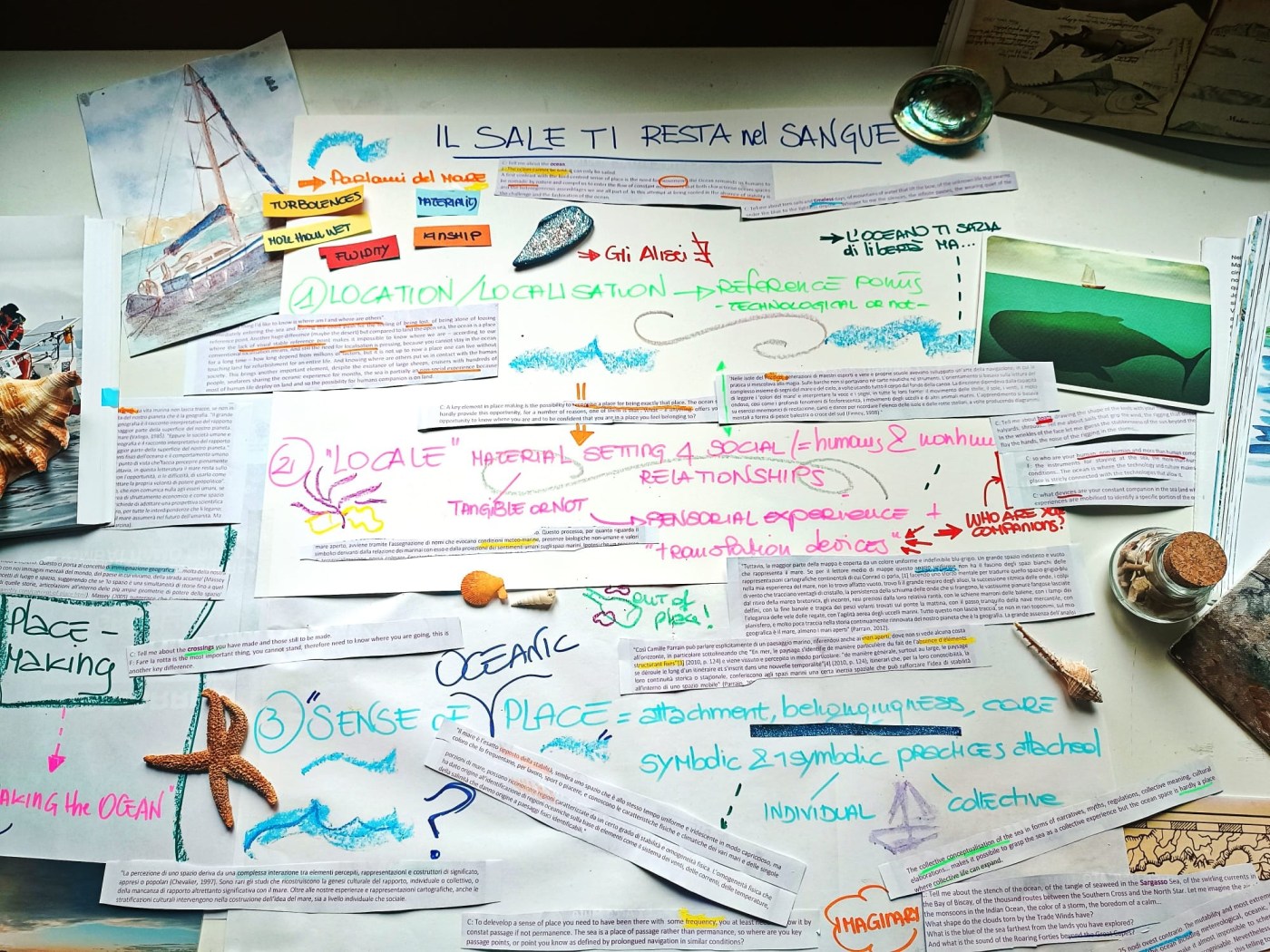
…“Tell me about the Ocean”
…“The Ocean cannot be told”
This paradox frames the enquiry developed in our recent article published in J-READING, which investigates the possibility of defining an Oceanic Sense of Place. Situated at the intersection of critical ocean studies and geographical debates on place-making, the paper examines how place emerges at sea through lived experience, relational practices, and embodied engagements rather than through fixed spatial anchors.
The article explores how the experiences of seagoing people contribute to the emergence of an Oceanic Sense of Place grounded in emotionally felt and collectively elaborated attachments to the sea. These attachments are articulated through oceanic imaginaries, narratives, symbols, specialised jargons, and systems of life developed in and through maritime practice. Central to this process is the recognition of kinship relations between human and more-than-human oceanic communities, positioning the ocean not as a passive backdrop but as an active participant in place-making.
Methodologically, the paper unfolds as a dialogue—an imaginary navigation into our relationship with the Ocean. It draws on reflective, qualitative, embodied, and embedded research practices, producing an auto-ethnographic and theory-informed dialogue on place-making in the high seas. In line with Donna Haraway’s call for “stories (and theories) that are able to gather the complexities and keep the edges open” (Haraway, 2016, pp. 100–101), the article resists closure, instead embracing uncertainty, relationality, and partial perspectives.
Through the creation of distinctive entanglements between bodies, technologies, affects, and oceanic materialities, the paper raises a series of interrelated questions:
Can the sea be considered a home? In what ways does an oceanic sense of place differ from land-based experiences of belonging? What technological translations and sensorial engagements render particular portions of the ocean recognisable and meaningful? And how might a fluid, transient, and temporally grounded sense of place challenge exclusionary practices tied to belonging, ownership, and the appropriation of common spaces?
By foregrounding movement, temporality, and relationality, the paper proposes the Oceanic Sense of Place as a critical lens through which to rethink dominant, land-centred understandings of place, belonging, and spatial justice.



Photo: Giuseppe Lupinacci
Read the full article in J-READING
http://www.j-reading.org/index.php/geography/article/view/446
 Chiara Certomà